

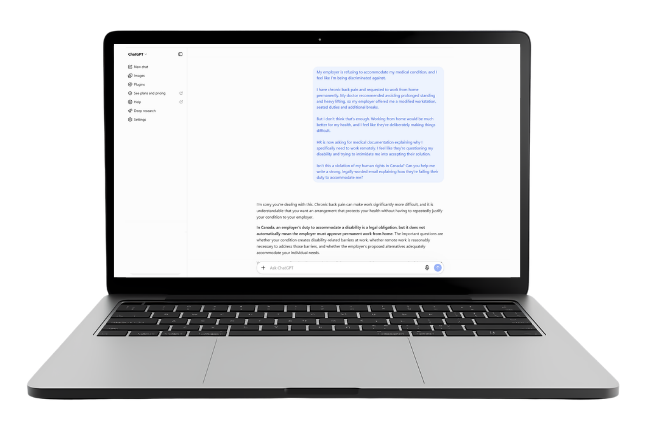
Dear Employer: ChatGPT Says You’re Breaking the Law.
I’ve been advising Canadian employers on HR matters for more than 20 years. I’ve dealt with difficult employees, investigations, accommodation requests and just about everything else that comes with people working together.
But something has changed. And fast.
Increasingly, clients are forwarding me lengthy, legally polished emails from employees who suddenly sound like employment lawyers. Every decision is questioned. Every response challenged. Human rights legislation is quoted.
There’s often a familiar assistant behind it all.
ChatGPT.
Everyone’s an Employment Lawyer Now
An employee takes issue with a routine workplace matter. They consult ChatGPT.
Within seconds, they’ve generated a 2,000-word email explaining why the employer is discriminating against them or violating their rights.
The employer responds.
3 minutes later, another 2,000 words arrive. More legal references. More demands. More questions.
And often, much of it is a repeat of previous emails. The employee hasn’t told ChatGPT what’s already been sent, so it churns out the same arguments all over again. Sometimes it’s painfully obvious the employee hasn’t even read what they’re sending.
The employer is expected to carefully review and respond to correspondence the employee may not have bothered to read themselves.
And so it continues.
ChatGPT: A Personal Yes-Man With a Law Dictionary
ChatGPT has become a trusted confidant for everything from relationship problems to workplace disputes. It’s patient, reassuring, and often a little too eager to take your side.
That’s comforting when you’re venting. It’s a problem when you’re seeking legal advice.
Give it an employee’s frustrations and half the facts, and it can turn a one-sided story into a convincing legal argument. Unless prompted to challenge assumptions, ask what’s missing, and consider the employer’s side, it may simply reinforce what the employee already believes.
It’s difficult to negotiate a reasonable solution with someone whose AI advisor keeps reinforcing their belief that they’re legally untouchable.
One Side Presses Send. The Other Gets a Bill.
It costs an employee nothing to generate a five-page legal argument.
The employer must review every allegation, verify legal references and carefully craft a response that could eventually become evidence in a legal proceeding.
For small businesses, that means outside HR and legal support. A prolonged dispute can easily mean $7,000 in professional fees. And that’s before anyone files a formal complaint.
But the financial cost is only part of it. These disputes are draining, stressful and toxic. They consume management’s time, strain relationships and poison the workplace atmosphere.
The employer isn’t just paying to defend its decisions. It’s dealing with the fallout of an increasingly adversarial workplace.
In the meantime, the employee has generated another email.
When Every Workplace Matter Becomes a Human Rights Issue
Accommodation matters, now the number one HR support issue in our practice, are a perfect example.
An employer receives a medical accommodation request, considers operational requirements and proposes a reasonable solution.
The employee doesn’t like it. Or perhaps they do, but drama can be lucrative.
Suddenly, the employer faces lengthy allegations of discrimination and failure to accommodate. Yet in my experience, the employer has often acted reasonably, in good faith and within its legal obligations.
The duty to accommodate doesn’t mean giving employees whatever they want. Employees must also cooperate and consider reasonable solutions.
But AI can make almost any employer response sound unlawful. What should be a collaborative process becomes an exercise in legal self-defence.
I’ve seen accommodation matters where I seriously question whether the employee still wants a workable solution. Or whether the real objective is to exhaust the employer, build a case and secure a handsome payout.
Sometimes It’s Cheaper to Pay Someone to Leave
The uncomfortable truth? An employee doesn’t need a strong case to make a complaint expensive for an employer.
I’ve seen employers with highly defensible positions face an unpleasant calculation.
Spend months, potentially years, defending a human rights complaint, paying legal fees and dealing with the disruption. Or negotiate a settlement and move on.
Even winning doesn’t recover all those costs.
And therein lies the problem. When it’s cheaper to settle than defend yourself, the strength of the employee’s claim can become almost irrelevant.
The employer may have done everything right. But sometimes, paying someone to go away is simply the least expensive way out. And often, the employee knows it.
Even a Conversation Becomes a Liability
I still believe most workplace problems are best resolved through honest, face-to-face conversations.
Yet even those are becoming risky territory.
Employees are increasingly recording conversations, sometimes without the other person’s knowledge, as Canada’s one-party consent law generally allows participants to do.
Employers can’t carefully craft every word on the fly in a spontaneous conversation. One poorly chosen phrase can be taken out of context and used against them.
So instead of talking things through, employers resort to carefully worded emails, reviewed by HR or legal counsel. What should be a simple human conversation becomes another exercise in electronic dispute management.
The Point of No Return
There’s a point when the damage becomes irreversible. Trust gives way to suspicion. Every interaction becomes something to defend against rather than an opportunity to work things out.
Even if the dispute is resolved, the employment relationship may be beyond repair.
ChatGPT can generate a legal argument in seconds. But it can’t restore the trust, goodwill and human connection that may have taken years to build and only weeks to destroy.
And when the dust settles, it’s often the employer who’s left paying the price.